Furniture Insights
News
How to Clean a Corduroy Sofa: Dust, Spills and Pile Care
To clean a corduroy sofa, remove dry, loose debris using a method approved for the upholstery, blot fresh spills promptly, and treat remaining stains only with a compatible cleaning product. Keep moisture within the fabric’s care instructions and avoid aggressive rubbing across the raised surface. A patch that looks darker or lighter also needs examination before cleaning: changes in the pile can affect appearance without necessarily indicating dirt.
Corduroy describes a ribbed fabric construction, rather than one specific fiber composition or cleaning requirement. Two sofas with similar-looking upholstery may need different treatment. The practical approach is to identify the material, distinguish the type of mark, and work through the affected area without unnecessarily disturbing the surrounding pile.
Examine the Mark Before Choosing a Cleaner
Corduroy has raised ribs separated by narrower channels. When inspecting it, look both at what is sitting between the ribs and at the condition of their soft surface.
Dry crumbs or visible dust call for a different response from a fresh drink spill. A smooth patch that changes in brightness as you move around the sofa may involve pile shading. That observation is a clue, not proof that the fabric is unstained or undamaged.
| What you observe | Appropriate starting point |
|---|---|
| Dry, loose particles between the ribs | Use the approved dry method, such as permitted vacuuming. |
| Fresh liquid on the surface | Blot the excess with a clean, dry, absorbent white cloth. |
| A persistent colored mark or dried residue | Identify the substance and check the approved stain-treatment method. |
| A patch that changes appearance with viewing angle | Examine the pile before applying cleaner or repeatedly brushing it. |
Photograph an unfamiliar mark before treatment. Include a close view of the ribs and a wider view showing its position on the sofa. If further advice becomes necessary, those images provide a clearer record than a description such as “the fabric looks dirty.”
Match the Cleaning Method to the Actual Upholstery
Find the care label or the care sheet associated with the selected fabric. The product name and upholstery reference are more useful than color alone.
Some upholstery labels use the following cleaning codes. Use them only when they appear on the actual product, and read the accompanying instructions.
| Code | General meaning |
|---|---|
| W | An approved water-based upholstery-cleaning method may be used. |
| S | A suitable water-free upholstery solvent is required. |
| WS or SW | Specified water-based or solvent-based upholstery methods may be permitted. |
| X | Routine cleaning is limited to vacuuming or light brushing as instructed; liquid cleaners are excluded. |
These codes do not establish that a cover can be soaked, machine washed, tumble dried or steam cleaned. An S code also does not authorize the use of arbitrary household solvents.
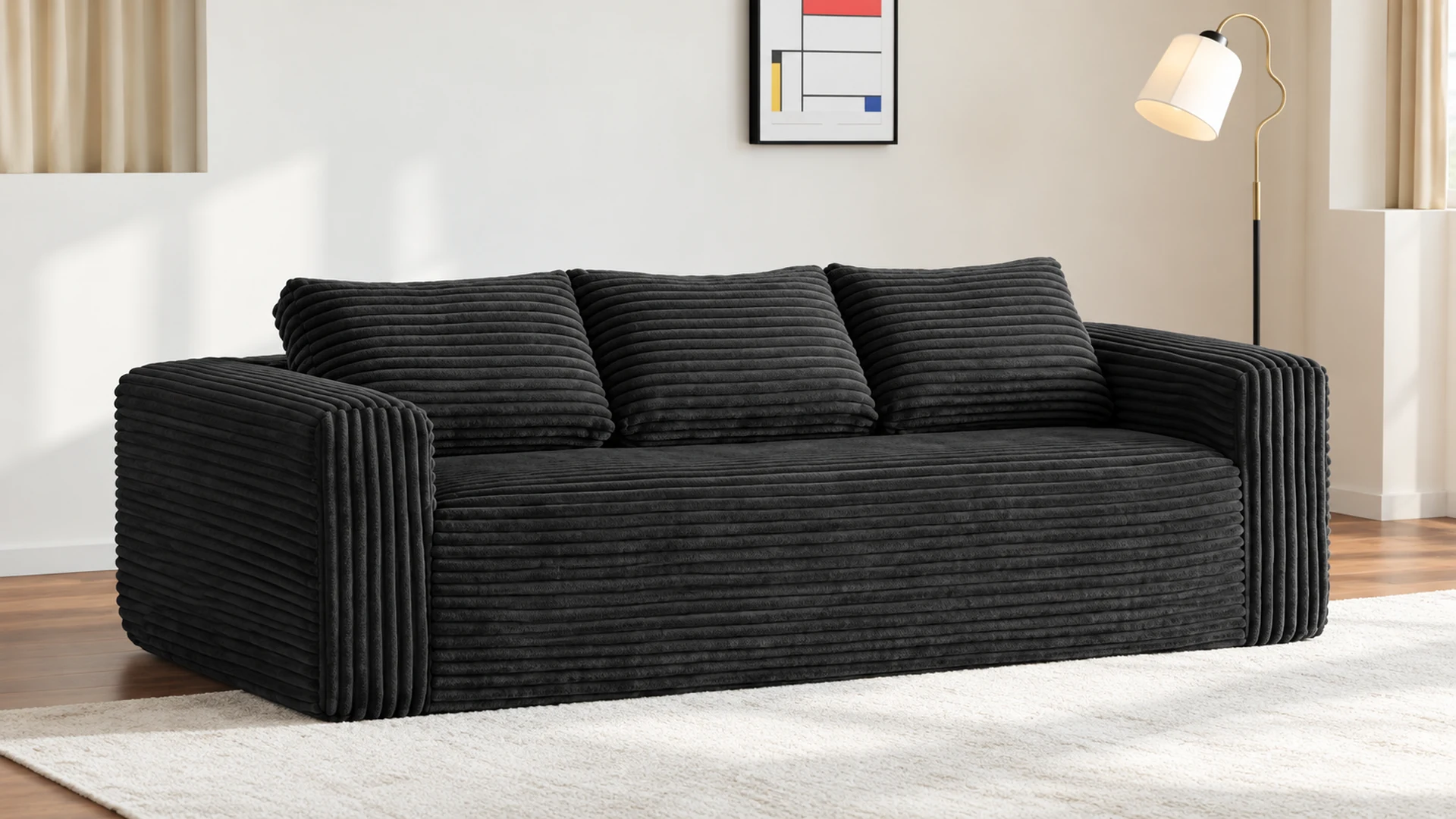
ScrapeSpace’s Dark Gray Striped Corduroy Compressed Three Seater Sofa is an example of a sofa with explicitly identified corduroy upholstery. Its fabric description establishes the surface type; cleaning products and treatment settings should match the care requirements for the upholstery supplied with the order.
If the care information is missing, limit the immediate response to gently absorbing a fresh spill and obtaining the correct instructions before applying a treatment.
Remove Dry Debris from the Ribs and Seams
Where vacuuming is permitted, use a clean upholstery attachment and gentle passes. Work across a small area at a time, checking both the raised ribs and the channels between them.
Include the arm-to-seat junctions, seams and accessible cushion gaps. Lift only cushions designed to be removed. Fixed upholstery should remain in place.
Do not press a narrow nozzle into the fabric to scrape out a particle. If the material pulls into the attachment, stop and adjust the method. A powered floor brush is not an appropriate default for an unfamiliar upholstery surface.
Visible rib direction and pile direction are separate considerations. Do not assume that brushing along the stripes will always be suitable. Where brushing is approved, follow the specified brush type and direction rather than repeatedly working the surface until its shade changes.
This process is for dry debris. Do not use an ordinary dry vacuum to collect a fresh liquid spill.
Treat Spills Without Spreading the Affected Area
Absorb Fresh Liquid First
Place a clean, dry, absorbent white cloth over the spill and blot gently. Lift between presses and move to a clean part of the cloth as it takes up liquid.
Avoid dragging the cloth across several ribs. This can spread the liquid over a wider area while disturbing the pile. Do not add a cleaner simply because some discoloration remains after the excess liquid has been absorbed.
For dried or sticky material, resist the temptation to scrape between the ribs with a sharp edge. Identify the substance and select an approved treatment before attempting to loosen it.
Test an Already Approved Treatment
A concealed-area test checks how the upholstery responds to a permitted product. It does not make an otherwise unsuitable cleaner acceptable.
Follow the product’s application instructions in a small, inconspicuous location. Stop immediately if you see color transfer, distortion or another adverse reaction. Otherwise, allow the test area to dry before comparing its color and texture with untreated fabric.
For corduroy, inspect the raised surface as well as the color. A cleaner that leaves no obvious stain may still change how the pile lies or feels.
Keep Treatment Controlled
Use the specified amount and application method. Do not increase concentration, add another household product or repeatedly wet the area because the first attempt has not removed the mark.
Keep liquid from saturating the cover and the cushion beneath it. If the stain spreads, a ring develops or the texture changes, stop treatment and record what has already been applied. An upholstery-cleaning professional can make a more informed assessment when the original spill and previous treatments are known.
Check Drying and Pile Appearance Before Reuse
Follow the drying requirements associated with the approved cleaning method. Keep the treated seating out of use until it is dry as instructed. Do not use an iron, hair dryer or steam treatment to correct a patch unless that procedure is specifically permitted.
Once dry, inspect the area under the same lighting and from the same position used before cleaning. Then view it from another angle. This helps separate a remaining mark from changes in how the pile reflects light.
Brush or groom the surface only where the care instructions allow it. Cleaning cannot be assumed to reverse worn fibers, permanent pressure marks or color loss. Repeated treatment intended to make every rib look identical may create a larger problem than the original mark.
Provide Care Instructions That Match the Supplied Sofa
For retailers and furniture brands, a useful care sheet should identify the sofa model, upholstery reference, approved cleaning method and relevant restrictions. Include what customers should photograph and report when a stain persists.
Keep that information tied to the selected fabric, especially when a sofa is available in several upholstery options. A successful cleaning method for one sample should not automatically become the instruction for the entire collection.
When discussing a ScrapeSpace corduroy sofa order, confirm the care requirements for the selected upholstery. Matching the instructions to the actual fabric gives customers a practical cleaning routine and helps retailers provide consistent after-sales advice.